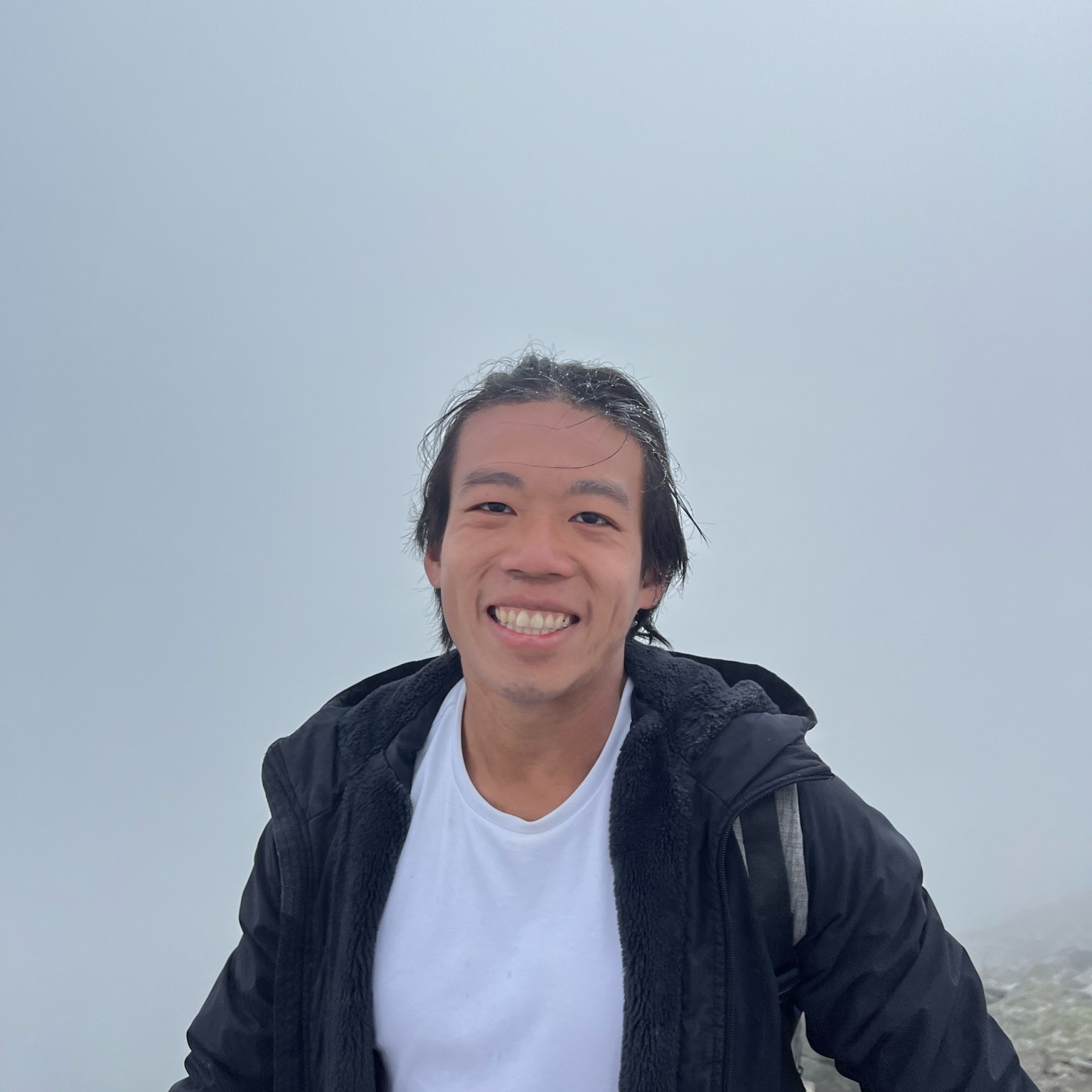
I work with Geoff Penington on quantum aspects of spacetime. Prior to this, I obtained my undergraduate degree in both Mathematics and Physics from MIT and worked with Hong Liu (my thesis advisor) and Xiao-Gang Wen.
My research spans quantum gravity, holography, and quantum many-body systems, with a particular focus on:
- Does “quantum mechanics + general relativity” imply “our universe is a hologram”?
- What’s the experience of an observer falling into a black hole? Does it hit a firewall?
The first question is arguably the holy grail of semiclassical quantum gravity. Why do I emphasize “semiclassical”? Because that’s the regime we live in: GR at the galaxy scale, QM at the nano lab scale, and some signatures of both from early-universe observations but nothing crazy. Importantly, I did not mention string theory, loop quantum gravity, etc. Just the most basic QM and GR, both well-tested by experiments. If the first question is true, that means although AdS/CFT is historically first derived in string theory, holography might be more fundamental about gravity than strings because it only relies on GR and QM. Many papers written by Geoff and myself are evidence for this claim. I find such a bottom-up perspective of holography, grounded in real-life observations, a lot more exciting.
Recently, I have been exploring AI research.
Recent News
September 2026 My paper with Geoff, Gautam, and Elisa “Holographic algebras at null infinity” is out! What can we learn about the bulk from a cut of null infinity? It turns out that the Bondi mass needs to be regulated carefully before it makes sense as a quantum operator. We use it to reconstruct bulk regions in asymptotically flat spacetimes, including a flat-space analogue of an entanglement wedge. We also recover generalized black hole entropy from a regulated von Neumann algebra. Interestingly, the algebras shrink as radiation escapes, giving an irreversible notion of holographic time evolution.
February 2026 My paper with Andreas “Time in gravitational subregions and in closed universes” is out! Inspired by my paper with Geoff, we study other features of spacetime. In this work, we dress to the curvature in 2D universe, and find explicit formulas for semiclassical entropies. Interestingly, the entropy agrees with generalized entropy if and only if the time flow is Killing on the slice. This challenges the distinguished role generalized entropies have played in our field.
November 2025 Thanks Institute for Advanced Study for having me for three weeks~
August 2025 Thanks University of Cambridge and Aron Wall for having me over the summer! Excited about the paper coming out (fingers crossed).
June 2025 My paper with Stefano, Henry, and Geoff “An apologia for islands” is out! It hopefully resolves confusion about constructing good operators in the presence of non-perturbative quantum gravity effects such as islands.
November 2024 I am invited to present my paper with Geoff in the “Information, Geometry and Physics Seminar” at Caltech!
June 2024: My paper with Geoff, “A clock is just a way to tell the time: gravitational algebras in cosmological spacetimes,” is out! I am very proud of this work. The notion of a “clock” should not be artificially engineered, but come from Nature itself. It has been unclear if this is compatible with both quantum mechanics and general relativity. We show how this can be done even just in semi-classical gravity, which we arguably live in, and use inflatons and evaporating black holes as examples.
May 2024: I am invited to present my paper with Andreas and Yasunori in the “New ideas for old black holes” workshop (private) at UC Berkeley!
March 2024: My paper with Andreas and Yasunori, “Firewalls at exponentially late times,” is out! We find that once wormholes are taken into account, an old enough black hole has 50\% chance of teleporting into a white hole.
May 2022: I get the Morse/Orloff Research Award from MIT! This is the best senior thesis award in theoretical Physics. You can find my thesis here, “Geometry and entanglement in AdS/CFT and beyond.”
April 2022: My paper with Xiao-Gang, “The boundaries of 2+1D fermionic topological orders,” is out! We present an algorithm for computing modular covariant wavefunctions for fermionic systems.
Awards
May 2022: Best senior thesis in theoretical physics from MIT, class 2022.
July 2018 Gold medal in the International Physics Olympiad (IPhO) in Portugal.
Contact
- Email: changhanc@berkeley.edu
Feel free to reach out to me!